 Full Editorial
Walk down any busy commercial street and watch how people behave. They keep their heads down, check their phones, and walk with purpose. They do not naturally look at storefronts unless something physically interrupts their line of sight.
If your retail shop or restaurant lives behind a perfectly flat brick facade, you are practically invisible to foot traffic. A flat building offers no visual friction. To get pedestrians to stop, look, and eventually walk through your door, you have to change the physical look of your building. One of the most cost-effective, high-ROI ways to do this is by installing a stationary awning.
Unlike temporary signs or sandwich boards that get ignored or tripped over, a permanent canopy acts as an architectural handshake. It reaches out over the concrete and actively pulls the street into your business. If you are trying to figure out why your foot traffic is low despite having a great location, look at your exterior. Here is exactly how adding a permanent fabric or metal structure over your door completely changes your curb appeal.
1. Breaking the Two-Dimensional Box
Most commercial buildings are built like shoeboxes. They are flat, rigid, and visually monotonous.
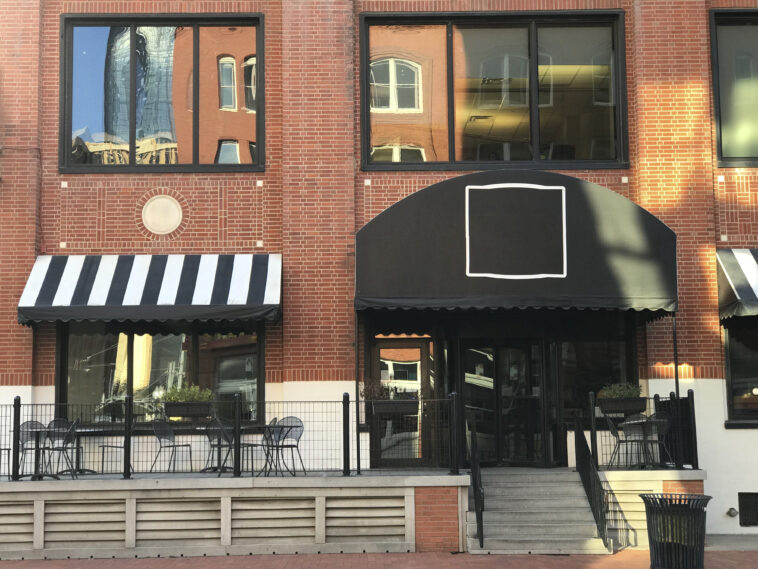
When you attach a fixed awning over your windows or entryway, you instantly add a third dimension to the property. It breaks up the harsh, flat lines of the masonry and introduces depth. This physical projection catches the eye of anyone walking or driving by. It tells the human brain, “Something is happening here. This space is occupied and active.” You can also use the shape of the frame to introduce new geometry. If your building is strictly composed of hard right angles, a classic dome or bullnose awning softens the exterior with a curve. If your building is an older, rounded brick structure, a sharp, modern wedge awning adds a contemporary edge.
2. Solving the “Glass Mirror” Problem
Here is a frustrating reality for visual merchandisers: if your store faces east or west, the sun is your worst enemy.
During the morning or late afternoon, direct sunlight hits your display windows and turns them into opaque mirrors. Pedestrians cannot see the beautiful mannequins, the fresh-baked goods, or the warm lighting inside your store. They just see a reflection of the street and the glare of the sun.
A permanent awning acts as a visor. By casting a deep, consistent shadow over the glass, it eliminates the glare entirely. It turns your front window into a high-contrast shadowbox, allowing people on the sidewalk to actually see the inventory you are trying to sell.
3. The Psychology of the “Pause”
Getting a customer to buy something requires getting them to walk in. Getting them to walk in requires getting them to stop walking.
Awnings provide physical shelter, and humans are biologically wired to seek shelter.
- The Rain Scenario: If a sudden downpour hits, pedestrians will sprint down the sidewalk looking for cover. If you have a deep, fixed awning, they will huddle under it to stay dry.
- The Summer Heat Scenario: In mid-July, people will naturally cross the street just to walk in the shade.
When people stop under your canopy to shake out an umbrella or escape the heat, they are a captive audience. They are standing directly in front of your glass, looking into your store. By providing a small, free comfort to the public, you drastically increase the chances of an impulse visit.
4. High-Visibility, 3D Branding
A flat sign mounted flat against your building is only fully legible to someone standing in the street directly in front of it. To the people walking down the sidewalk parallel to your store, that sign is just a thin line.
Awnings project your brand outward. Because the structure extends over the sidewalk, you can print your logo, your street number, or your business name on the side valances. This means a pedestrian walking from three blocks away can clearly read your signage. You are essentially claiming the airspace above the public sidewalk as a 24/7, unignorable billboard.
Furthermore, color theory plays a massive role here. A bright crimson, deep navy, or classic black-and-white striped canvas becomes a geographic landmark. People stop saying, “We are at the address on Main Street,” and start saying, “We are right next to the bakery with the big red awning.”
5. Expanding the Usable Footprint
Curb appeal isn’t just about the building; it is about how the space outside the building is utilized. If a coffee shop puts two metal chairs on a bare concrete sidewalk, it looks like an afterthought. It feels exposed to the traffic and the elements. But if you put those exact same two chairs directly beneath a handsome, structured canopy, it suddenly becomes a patio.
The awning creates a perceived ceiling. It defines an outdoor room. Whether you are a restaurant expanding your seating capacity, a boutique putting a clearance rack outside, or a hardware store displaying bags of soil, the space beneath the awning looks intentional, curated, and professional.
6. Masking Ugly Architecture
Sometimes, curb appeal is about hiding the negative rather than adding a positive. Many older commercial spaces have awkward facades. There might be an ugly, rusted HVAC vent directly above the front door. The masonry might be mismatched from an old renovation. There might be a massive, dead space between the top of the doorframe and the roofline that makes the building look vacant.
A custom-fabricated, stationary awning acts as a massive cosmetic bandage. You can size the frame to completely cover unsightly architectural flaws, hiding the messy wiring or peeling paint behind a taut, vibrant stretch of commercial-grade fabric.
Make Your Storefront Stand Out
Storefront design is a competitive sport. If you expect a small neon “Open” sign to do all the heavy lifting, you are leaving money on the table.
Investing in a stationary, custom-built canopy changes the entire presence of your business. It protects your inventory from sun damage, shelters your customers from the weather, projects your branding down the block, and turns a forgettable brick box into a welcoming destination. It is one of the few exterior renovations that genuinely pays for itself in increased foot traffic.