
 Full Editorial
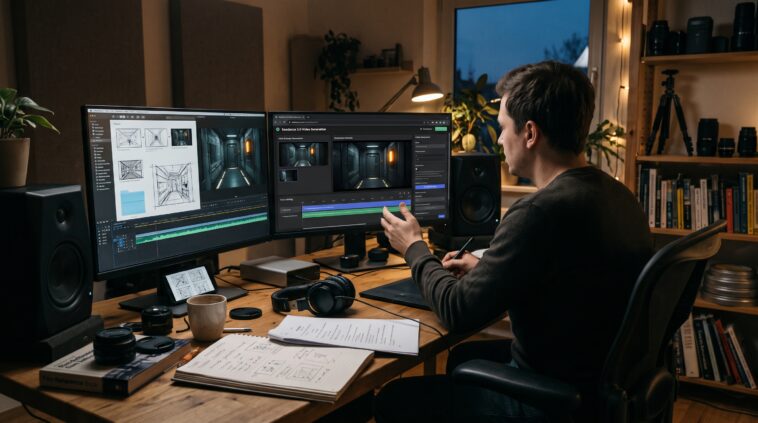
A light turns amber at the far end of an empty corridor. Nothing else happens, but the sound of ventilation begins to fade. I would use that small change as the premise for a science-fiction scene study. The proposed film would not need a fleet of spacecraft or a crowded control room. Its tension would come from a familiar space behaving differently.
To explore the idea in motion, I would build a visual concept with Seedance 3.0, an AI video workflow that can bring reference material and written direction together. My initial reference would be an original corridor design with a door, a wall light, and a narrow strip of floor illumination. The first shot would ask the viewer to notice those relationships before anything changes.
I would treat the result as a concept preview rather than completed production footage. It could help me decide where to put the camera, how long to hold the opening, and whether the light change communicates enough. Those are concrete filmmaking questions. A polished-looking image is only useful if it helps the scene’s visual idea become clearer and more consistent.
Give the space a simple geography
My corridor would have one door at the end and a shallow recess on the right. The recess would create a patch of darkness without introducing another location. I would draw or photograph references that establish these features clearly. A complicated maze of doors might look impressive, but it would make the viewer spend the opening trying to understand the layout.
I would choose a restrained palette: cool walls, a neutral floor, and the single amber signal. That color change would be the scene’s main event. If every panel glows in a different color, the audience may not notice the one light that matters. The design should make the dramatic action legible before I ask a camera movement to enhance it.
The reference would contain no exact interface text or borrowed franchise symbols. I would keep the world original and add any required labels later in an editing or compositing application. A generic warning panel can suggest a function through placement and light. It does not need a paragraph of invented technical language to make the corridor feel purposeful.
Hold the frame before changing it
For the first Seedance 3.0 shot, I would keep the camera still at waist height, looking toward the door. The opening would give the audience time to register the floor strip and the wall light. Only then would the amber change occur. A moving camera from the first frame could make the same moment harder to read, because everything would already be shifting.
I would create the light change as a separate controllable beat if one generated clip cannot preserve it cleanly. Two stable views could be connected in the edit, with the change supported by sound. The scene does not require a technically elaborate continuous take. It requires the viewer to understand that something in the room has changed and that the change has consequences.
A possible draft problem would be a door that alters shape when the signal changes. I would compare the frame edges and wall panels, then simplify the brief. If the geometry remains inconsistent, I would keep the best stable image and explore a smaller light variation. Fixing the part that carries the story would be more valuable than preserving an ambitious but distracting effect.
Move closer only when the scene earns it
The second shot would advance slowly toward the door after the signal has changed. I would leave the right-hand recess visible for part of the move, maintaining the corridor’s geography. The camera’s approach would express attention rather than speed. There would be no need to reveal a creature or an unseen person; the unanswered space itself can sustain a brief moment of anticipation.
In Seedance 3.0, I would describe this as one controlled forward movement with the door remaining closed. I would avoid combining a door opening, a sudden camera turn, and a lighting failure in the same request. Each additional event could obscure the original idea. A focused shot lets me evaluate whether the approach adds tension or simply repeats the information already established.
I would cut the movement before it reaches the door. The last image could hold on the amber reflection crossing the floor, leaving the next action outside this short study. That ending would give the scene a boundary. A concept preview can be complete as an exploration of anticipation even when the larger fictional story remains deliberately unresolved.
Use sound to make the change perceptible
The opening sound would be a steady, low ventilation hum made from recordings I can use. When the light changes, I would reduce one layer of that hum rather than add an enormous impact. A subtraction can make the room feel suddenly different. The audience might notice the quiet before understanding why, which suits the scene’s restrained visual language.
Any Seedance 3.0 audio draft would be checked for unexpected dialogue, footsteps, or alarm sounds. Those details could imply a story I have not chosen to tell. I would keep the final soundtrack under editorial control, using original or properly licensed material. The sound should help the light change register without suggesting that the corridor is full of invisible activity.
I would compare a version with a brief electronic tone against one with only the altered hum. The tone may make the signal clearer, while silence may feel more mysterious. I would watch both with the same picture edit and decide which serves the intended audience. The comparison would answer a specific storytelling question instead of becoming a search for a generally more dramatic soundtrack.
Turn the study into a useful filmmaking reference
The final Seedance 3.0 edit would contain an establishing view, the signal change, and an approach that stops short of the door. I would export it with a clear concept-study label and keep the visual references beside it. If the project later moves into physical production, those materials could help discuss framing and rhythm without pretending that the generated room is a built set.
I would review the sequence on a small screen as well as a larger display. The amber light must remain visible, and the dark recess should not become an unreadable patch. A slight adjustment in contrast could help, but I would avoid brightening the whole image until the mood disappears. The test is whether the important change can be understood at normal viewing size.
This Seedance 3.0 exercise would let me explore how much a simple space can communicate through timing, light, and sound. I would judge it by the clarity of those choices, not by an invented budget saving or a promise about box-office success. The desired result is a short, readable scene concept that gives a filmmaker something concrete to refine before expanding the story.