
 Article Editor
Business operations are changing as companies look for better ways to manage information, reduce repetitive work, and respond to customer demands. Traditional software may no longer be sufficient when departments rely on disconnected applications and manual processes.
Enterprise Resource Planning (ERP) systems help businesses bring important activities into a connected environment. However, modern ERP solutions are evolving beyond basic record management. New technologies are creating opportunities for smarter workflows, faster reporting, and more flexible business operations.
For companies investing in ERP development in Singapore, understanding these trends can help them make informed technology decisions and prepare for future growth.
1. Artificial Intelligence in ERP Systems
Artificial intelligence is becoming a valuable addition to business software. Within ERP systems, AI can help analyze sales patterns, identify unusual transactions, generate forecasts, and assist with routine administrative activities.
For example, a distributor could use AI-supported demand forecasting to estimate future product requirements and adjust purchasing plans. Finance teams may also benefit from automated invoice processing and transaction classification.
Businesses should introduce AI where it solves a genuine operational problem and maintain appropriate human oversight for important decisions.
2. Cloud-Based ERP Solutions
Cloud ERP allows authorized users to access business information through internet-connected devices without depending entirely on locally maintained infrastructure.
This approach can support organizations with remote employees, multiple offices, and distributed operations. It may also simplify software updates and system maintenance, depending on the provider and deployment model.
When evaluating cloud-based ERP development, companies should consider data security, access permissions, service availability, integration requirements, and ongoing subscription costs.
3. Low-Code Development and Faster Customization
Business requirements often change as companies expand. Low-code platforms provide visual tools that can help developers build forms, approval processes, dashboards, and other applications with less traditional coding.
These tools can be useful for straightforward workflows that need to be introduced quickly. However, complex business rules or specialized integrations may still require conventional programming.
A practical ERP strategy combines development speed with careful attention to long-term flexibility, platform limitations, and maintenance.
4. Greater Integration Between Business Applications
Many companies use separate platforms for accounting, customer relationship management, inventory, e-commerce, and human resources. When these applications do not communicate effectively, employees may have to enter the same information repeatedly.
Modern ERP development focuses on connecting these systems through suitable integrations and APIs. For instance, an online order could update inventory records, notify the fulfillment team, and provide relevant information to the accounting department.
This connected approach helps reduce duplicated work and improves visibility across business functions.
5. Real-Time Reporting and Business Intelligence
Managers need reliable information to understand performance and respond to problems. Modern ERP systems can bring together operational and financial data to create dashboards and reports.
Businesses can monitor sales activity, outstanding payments, stock availability, purchasing expenses, and other important indicators. More frequent access to relevant information can help decision-makers recognize emerging issues earlier.
For organizations considering ERP development in Singapore, reporting requirements should be defined before development begins to ensure that the system captures the information management actually needs.
6. Stronger Security and Access Management
As ERP systems connect more departments and applications, protecting business information becomes increasingly important.
Companies are paying greater attention to role-based permissions, multi-factor authentication, audit trails, secure integrations, and backup procedures. These controls help restrict access to appropriate users and support investigation when unusual activity occurs.
Security should be incorporated into the ERP design from the beginning rather than treated as a final implementation task.
7. Industry-Specific ERP Development
A single software configuration rarely suits every industry equally well. Manufacturers may require production scheduling and material traceability, while retailers need accurate stock visibility and order management.
Industry-focused ERP development allows businesses to configure workflows, reports, and integrations around their actual operational needs. This can reduce unnecessary complexity and make the software more useful for employees.
Conclusion
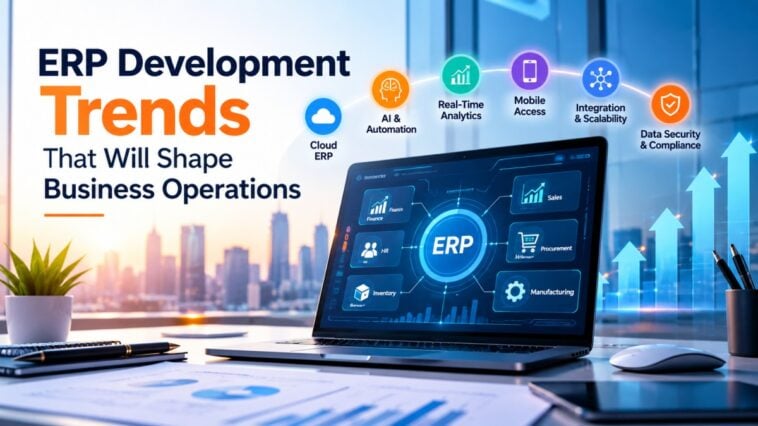
ERP development is moving toward more connected, adaptable, and intelligent business systems. AI, cloud technology, low-code tools, application integration, real-time reporting, and stronger security are influencing how organizations manage daily operations.
Businesses exploring ERP development in Singapore should prioritize technologies that address measurable challenges instead of adopting trends without a clear purpose. SerpentCS helps businesses explore ERP solutions aligned with their workflows, integration requirements, and growth plans, supporting more efficient operations and long-term business development.