
 Article Editor
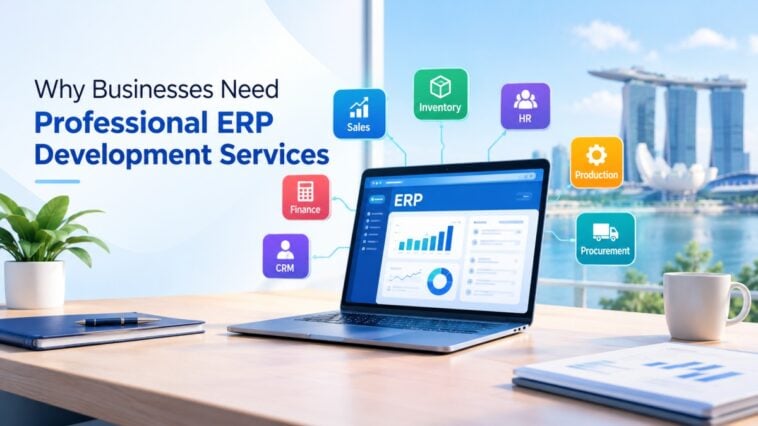
Businesses today need efficient systems to manage daily operations, organize data, and improve productivity. Managing finance, inventory, sales, customer relationships, and human resources through separate systems can create delays and data inconsistencies. This is where professional ERP development services can help.
Enterprise Resource Planning (ERP) software brings different business functions together on a centralized platform. Businesses may improve reporting, expedite processes, and make better business decisions with the right ERP solution. For growing businesses in Singapore, investing in customized ERP software can be a practical step toward long-term operational efficiency.
What Are ERP Development Services?
ERP development services involve designing, developing, customizing, and integrating software that helps businesses manage their core operations. Depending on business requirements, an ERP system can include modules for accounting, inventory management, procurement, sales, human resources, production, and customer management.
Unlike disconnected business applications, an integrated ERP platform allows departments to work with shared information. This reduces repetitive data entry and helps teams maintain consistent records.
Businesses can choose custom ERP software development when standard solutions do not meet their specific workflows, reporting requirements, or integration needs.
Why Do Businesses Need Professional ERP Development Services?
1. Improve Operational Efficiency
Manual processes and disconnected applications can slow down business operations. Professional ERP development services help automate repetitive tasks, standardize workflows, and reduce administrative work.
For instance, a distribution company can use a single ERP platform to link its purchasing, sales, and inventory processes. When an order is placed, the system can update stock records and provide relevant information to the purchasing team.
This integrated approach helps businesses save time and manage daily activities more efficiently.
2. Centralize Business Data
When departments maintain separate spreadsheets and applications, finding accurate information becomes difficult. ERP software centralizes essential business data, giving authorized employees access to consistent and updated records.
Management may more efficiently produce corporate reports, evaluate sales performance, review inventory levels, and keep an eye on spending with the use of a centralized database.
For companies operating across multiple locations in Singapore, centralized data management can also improve coordination between teams.
3. Support Better Business Decisions
Business decisions depend on reliable information. ERP systems can provide dashboards, performance reports, financial summaries, and operational insights to help managers understand business performance.
With appropriate reporting features, companies can identify sales trends, monitor cash flow, evaluate resource utilization, and recognize potential operational problems.
Professional ERP developers can configure reporting tools according to a company’s specific goals, helping decision-makers access the information they need.
4. Customize Software to Match Business Needs
Every business has different processes and priorities. A manufacturing company may require production planning and quality control, while a retail business may prioritize inventory tracking, order processing, and customer management.
Additionally, it can facilitate interaction with CRM systems, e-commerce platforms, accounting software, and other corporate applications.
This flexibility helps organizations build an ERP solution around their workflows instead of forcing every department to follow unsuitable processes.
5. Strengthen Data Security and Access Control
Business systems often contain confidential financial, employee, supplier, and customer information. A professionally developed ERP platform can incorporate role-based access control, authentication, activity logs, and other security measures.
These features help businesses control who can view, modify, or approve specific information.
Companies should also consider regular software updates, secure backups, disaster recovery planning, and appropriate data protection practices when implementing an ERP solution.
6. Make Business Growth Easier
As companies expand, their operational requirements become more complex. More customers, employees, suppliers, and transactions can put pressure on existing systems.
Scalable ERP software can accommodate additional users, business units, workflows, and modules as requirements change.
For growing companies in Singapore, a well-planned ERP solution can support business expansion while reducing dependence on disconnected applications and manual processes.
Why Are Experienced ERP Developers Important?
Choosing experienced ERP developers is essential for building a solution that works reliably and supports business objectives. ERP development involves more than creating software interfaces; it requires understanding business processes, data structures, integrations, security, and user requirements.
Professional developers can help businesses with:
- Requirement analysis: Understanding operational challenges and defining essential ERP features.
- System architecture: Designing a solution that supports current needs and future expansion.
- Custom module development: Building features for finance, inventory, HR, procurement, or other business functions.
- Testing and deployment: Identifying errors and preparing the system for practical use.
- Maintenance and support: Resolving issues, improving performance, and updating the software as business needs evolve.
Working with a capable development partner can help reduce implementation risks and improve the overall usability of the ERP system.
Choosing ERP Development Services in Singapore
Singapore’s varied business environment includes manufacturing firms, logistics firms, technology firms, and professional service firms. Companies in these industries could have varied needs when it comes to reporting, inventory control, automation, and financial management.
When evaluating ERP development services in Singapore, consider the provider’s technical expertise, experience with similar projects, customization capabilities, integration approach, security practices, and ongoing support.
SerpentCS is a company businesses can explore when evaluating ERP-related development and implementation support. Before selecting a provider, review its service portfolio, relevant project experience, technology expertise, and ability to understand your operational requirements.
It is also important to discuss project timelines, implementation costs, data migration, employee training, and post-launch maintenance before beginning development.
How ERP Software Development Can Be Started
A successful ERP project starts with a clear understanding of business problems and priorities.
First, identify the processes that need improvement. Next, determine which ERP modules are essential and which integrations are required. Involve staff members who will frequently utilize the system, set quantifiable project goals, and create a reasonable budget.
Begin with the most important business functions and expand the platform as needed. Testing, employee training, and ongoing performance monitoring should remain part of the implementation plan.
Conclusion
Professional ERP development services help businesses automate workflows, centralize information, improve reporting, and prepare for growth. With customized features and reliable integrations, an ERP system can connect departments and support more efficient business management.
For businesses in Singapore, choosing the right ERP development partner requires careful evaluation of technical capabilities, business understanding, security, and long-term support. Experienced ERP developers can turn operational requirements into a practical software solution that evolves alongside the organization.
By investing in a well-planned ERP system and working with a suitable technology partner such as SerpentCS, businesses can build a stronger foundation for efficient and sustainable operations.