
 Adam Torkildson
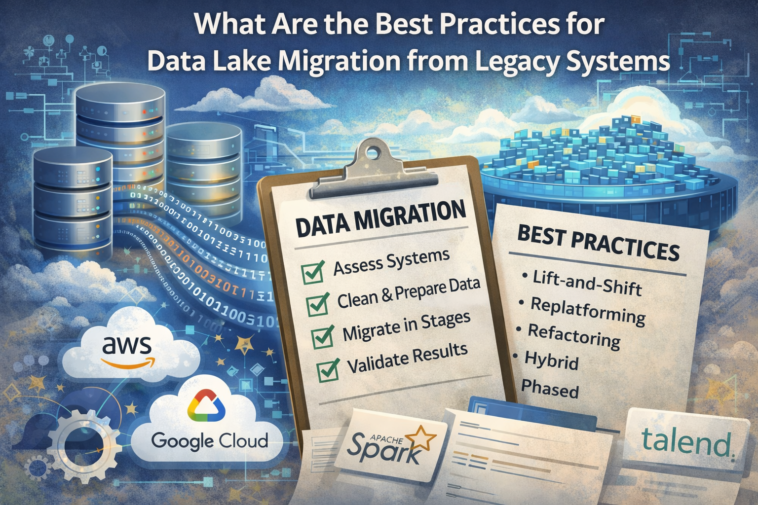
The best data lake migration best practices from legacy systems focus on a structured, phased approach that minimizes risk while maximizing data quality and performance. In simple terms, organizations should assess their existing systems, clean and prepare data, migrate in stages, and continuously validate results. This ensures a smooth transition without disrupting business operations. A well-planned data modernization strategy also helps align migration efforts with long-term business goals, making the move to a data lake more efficient and scalable.
All Practices for Data Lake Migration
A successful data lake migration starts with choosing the right approach based on your organization’s goals, data complexity, and available resources. There are several proven migration methods, each with its own advantages and trade-offs. Understanding these approaches helps businesses reduce risk, control costs, and ensure a smooth transition to modern data platforms.
Lift-and-Shift (Rehosting)
This approach involves moving data and workloads to a new environment without making significant changes. It is the quickest way to migrate but does not improve the existing architecture.
Replatforming
Replatforming introduces minor optimizations during migration, such as improving performance or adjusting configurations, without fully redesigning the system.
Refactoring (Re-architecting)
This method involves redesigning the data architecture to fully leverage modern data lake capabilities, such as scalability, automation, and advanced analytics.
Hybrid Migration
Hybrid migration combines on-premises and cloud environments, allowing businesses to transition gradually while maintaining some existing systems.
Phased Migration (Recommended)
Phased migration moves data in stages rather than all at once. It is often combined with selective refactoring to improve critical components while minimizing disruption. This approach is widely considered the most effective because it balances risk, cost, and long-term performance.
Comparison of Data Lake Migration Approaches
| Migration Approach | Pros | Cons |
| Lift-and-Shift (Rehosting) | Fast deployment, low initial cost, minimal disruption | No optimization, may transfer existing issues |
| Replatforming | Improved performance over rehosting, moderate effort | Limited modernization benefits |
| Refactoring (Re-architecting) | High scalability, optimized performance, future-ready architecture | Expensive, time-consuming, requires expert resources |
| Hybrid Migration | Flexible transition, reduced immediate risk | Complex to manage, potential integration challenges |
| Phased Migration (Best Option) | Lower risk, better control, allows testing and gradual optimization | Longer timeline, requires detailed planning |
By carefully evaluating these approaches, organizations can choose a strategy with the help of data migration consultants that not only ensures a smooth migration but also builds the foundation for long-term data success.
Common Challenges in Legacy-to-Data Lake Migration
Migrating from legacy systems to a data lake is not without challenges, and understanding them is key to success. Data quality and inconsistency often arise due to outdated or duplicated records in legacy systems. Complex dependencies between old systems can make it difficult to extract and transform data efficiently. Security and compliance risks must also be addressed, especially when handling sensitive or regulated data. Additionally, downtime and business disruption can occur if migration is not carefully planned. Finally, many organizations face skills and resource gaps, as modern data platforms require new expertise and tools.
Tools and Technologies for Data Lake Migration
Choosing the right tools is essential for implementing effective data lake migration best practices.
- Cloud platforms: AWS, Azure, Google Cloud: Provide scalable and cost-efficient infrastructure for storing and processing large datasets.
- Processing tools: Apache Spark, Hadoop: Enable fast and distributed data processing for large-scale workloads.
- Integration tools: Talend, Fivetran, Informatica: Simplify data extraction, transformation, and loading across systems.
- Metadata tools: Apache Atlas, AWS Glue: Help manage data cataloging, governance, and lineage tracking.
FAQs
What is the best strategy for data lake migration?
A phased (incremental) migration combined with strong governance and testing is the most effective approach.
Which tools are used for data lake migration?
Popular tools include AWS S3, Azure Data Lake, Apache Spark, Talend, and Informatica.
How long does a data lake migration take?
It depends on data complexity and volume, typically ranging from weeks to several months.
Is migrating to a data lake cost-effective?
Yes, it reduces storage costs and improves scalability compared to legacy systems.
Conclusion
Adopting the right data lake migration best practices from legacy systems is essential for ensuring a smooth and successful transition. By choosing a phased approach, addressing common challenges, and leveraging the right tools, organizations can minimize risks and maximize value. A well-executed migration not only modernizes data infrastructure but also supports advanced analytics, scalability, and long-term growth. Ultimately, a thoughtful and strategic approach transforms migration from a complex task into a powerful opportunity for innovation.