
 Full Editorial
Walk into your favorite local lunch spot on a Tuesday at noon. You know the look. The host stand is empty. The manager is sweating behind the bar, trying to pour drinks while simultaneously answering the phone. There is a handwritten sign taped to the door that says, “Please be patient, we are short-staffed.”
It feels like we have been living in this temporary state of emergency for years now. But at some point, we have to admit that it isn’t temporary. The hospitality labor market has fundamentally shifted. The flood of applicants isn’t coming back, and the staff you do have are hovering on the edge of burnout.
For decades, the hospitality industry resisted automation. We clung to the idea that service had to be face-to-face to be “real.” We thought a screen created a wall between the guest and the host. But when you are running a skeleton crew during a Friday night rush, a screen isn’t a wall. It is a life raft.
This is why the rollout of commercial-grade touchscreen products has moved from a “nice-to-have” luxury to an operational requirement. It isn’t about replacing people with robots; it is about saving the people you actually have. By offloading the repetitive, low-value tasks to a digital interface, you free up your team to do the one thing a computer can’t do: actually take care of the guest.
Here is the reality of how hardware is filling the gaps in the labor market and keeping the lights on.
1. Stop Paying People to Do Data Entry
Let’s be honest about the order-taker role. Standing behind a register and punching in “Cheeseburger, No Pickles” is not hospitality; it is data entry. Right now, using one of your three available employees to stand still behind a counter is a waste of a human being.
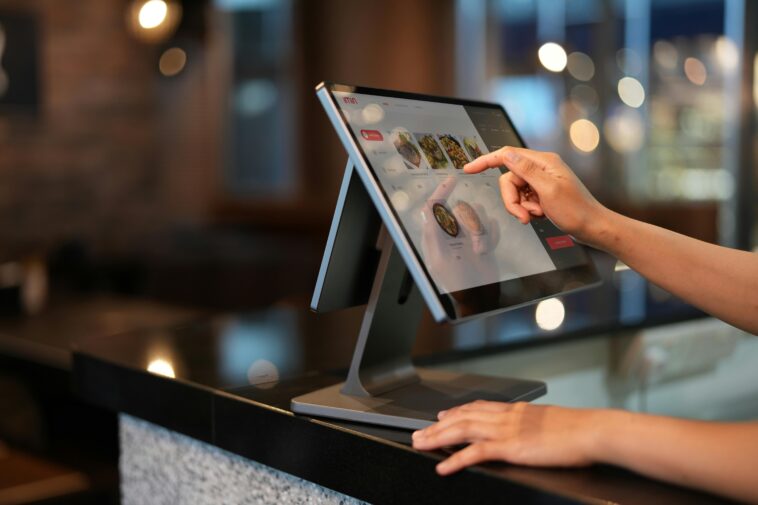
Self-service kiosks change the dynamic completely. When a guest enters their own order on a touchscreen, the error rate drops to near zero. This kills the frustration of food being sent back to the kitchen, which creates stress for everyone. But the real magic is the pivot. The employee who used to be stuck at the register is now free to run food, refill drinks, bus tables, or actually talk to customers. You haven’t lost a worker; you have gained a floor general. You are redeploying labor to where it actually impacts the experience.
2. Taming the Kitchen Nightmare
The labor crisis is often invisible to the guest because it is happening in the back of house. Line cooks are the hardest role to fill and the hardest to keep. In a traditional kitchen, a line cook is dealing with the chaotic line of paper slips that get greasy, fall on the floor, or get reorganized by a stressed expeditor. It is a high-pressure environment that chews people up.
Kitchen display systems, robust touchscreens mounted right on the line, act as a silent manager. They automatically route items to the right station (grill vs. fry). They color-code orders based on how long they have been waiting. They ensure the fries and the burger finish at the exact same moment. This might seem like a small tech upgrade, but it lowers the cognitive load on your cooks. They don’t have to memorize timing; they just have to cook. A calmer kitchen is a kitchen where people want to stay. By reducing the chaos, you reduce the turnover.
3. The Tech Training Curve
Even when you do manage to hire someone, they are likely young and inexperienced. In the past, training a new server on a legacy point of sale (POS) system—with its arcane codes and hidden sub-menus—could take two weeks. You don’t have two weeks. You need them on the floor tonight.
We live in an era where every single applicant has a supercomputer in their pocket. If your interface looks and acts like a smartphone, the training time drops from days to hours. “Swipe right to delete.” “Tap to add.” This intuitive design is critical when you have a revolving door of staff. It allows a new hire to be productive on their very first shift, rather than shadowing someone for a week and dragging down the rest of the team’s efficiency.
4. Rugged vs. Retail
There is a temptation for small business owners to run to the nearest electronics store, buy a stack of consumer tablets, and slap them on the counter. This is a mistake that usually costs more in the long run.
Consumer tablets are built for browsing the internet on a couch. They are not built for a commercial kitchen. They aren’t built for the heat of a fry lamp, the grease of a burger station, or the constant, aggressive tapping of thousands of strangers. When you are already short-staffed, a broken screen is a disaster. It brings the operation to a screeching halt. This is why purpose-built hardware matters. You need screens that are water-resistant, dust-proof, and capable of surviving a drop. Reliability is a form of labor support. It ensures that the tools work so the team can work.
5. The Hotel Lobby Bottleneck
The labor shortage isn’t just about food; it’s hitting hotels hard. The 3:00 PM check-in rush used to be managed by four front desk agents. Now, it might be managed by one harried employee and a manager who is also trying to answer the phone. The result is a line of angry travelers winding out the door.
Check-in kiosks are the pressure valve. They allow the business traveler who just wants to get to their room to bypass the line, scan their ID, make their key, and go. This leaves the human agent free to help the family of five that has complex questions about the pool hours and local dining recommendations. Again, the technology isn’t removing the hospitality; it is segmenting it. It allows the human connection to be reserved for the guests who actually need it, rather than wasting it on administrative tasks like swiping credit cards.
Embrace Touchscreen Technology
The “good old days” of unlimited labor are gone. We aren’t going back to a world where you can easily hire ten experienced servers for a single shift. The future of hospitality is hybrid. It is a blend of high-tech efficiency and high-touch service. By embracing touchscreen technology, you aren’t admitting defeat. You are building a fortification around your business. You are creating a system where your staff can breathe, your kitchen can flow, and your guests can get what they paid for—even if you are two people down on a Saturday night.