
 Full Editorial
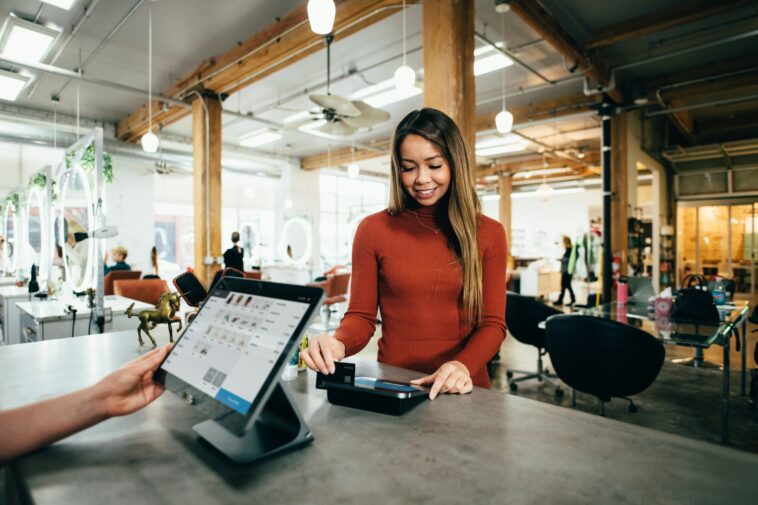
Running a retail business today looks nothing like it did even five years ago. Customers expect a seamless experience whether they’re browsing online, walking through the door, or doing both in the same afternoon. Meanwhile, the margin for error keeps shrinking — rising costs, tighter competition, and higher customer expectations mean small mistakes show up on the bottom line faster than ever.
The good news is that the same technology reshaping how customers shop is also making it easier for growing retailers to run tighter, smarter operations. You no longer need an enterprise budget to access tools that were once reserved for the big chains. Here are five categories of tools worth putting on your radar in 2026, whether you’re running a single storefront or managing a handful of locations.
1. Point-of-sale systems built for more than just checkout
A modern point-of-sale (POS) system is the backbone of daily operations, but the best ones do far more than ring up sales. Look for a platform that combines checkout with inventory tracking, customer data, and sales reporting in one place. This gives you a real-time view of what’s selling, what’s sitting on the shelf, and which customers keep coming back.
For a growing business, the real value comes from consolidation. Instead of juggling a separate cash register, spreadsheet, and loyalty program, a good POS ties everything together so you’re not manually reconciling numbers at the end of every week. That saved time adds up quickly once you’re managing more than one location.
2. Inventory management software
Nothing eats into profit faster than getting inventory wrong. Order too much of a slow-moving item and you’re stuck with cash tied up in stock that isn’t moving. Order too little of a bestseller and you’re turning away sales you already earned through marketing and foot traffic.
Dedicated inventory management software helps growing retailers track stock levels across locations, set automatic reorder points, and spot trends before they become a problem. Some platforms now use predictive tools to flag when a product is likely to sell out based on historical patterns, giving store owners a head start on reordering instead of reacting after the shelf is already empty. For a business expanding into multiple stores or adding an online storefront, this kind of visibility quickly becomes non-negotiable rather than a nice-to-have.
3. Merchandising and store layout tools
How products are displayed has a direct impact on what actually sells. A cluttered shelf, a poorly lit display, or a layout that doesn’t guide customers naturally through the store can quietly cost a retailer sales every single day, even when the products themselves are perfectly good.
This is where dedicated merchandising apps come in. These tools help retailers plan planograms, test different shelf layouts, and make sure high-margin or high-demand products get the visibility they deserve. For businesses with more than one location, they also make it far easier to keep store layouts consistent, so a customer walking into any branch has a similar, well-organized experience. As a business grows past a single storefront, relying on memory or a manager’s personal judgment for shelf layout stops scaling — having a system in place keeps merchandising decisions consistent and data-informed.
4. Customer relationship management (CRM) platforms
Retail success increasingly depends on repeat business, not just walk-in traffic. A CRM platform helps store owners keep track of customer preferences, purchase history, and communication in one place, rather than relying on memory or a notebook behind the register.
For a growing retail business, this becomes especially valuable when running promotions or loyalty programs. Instead of blasting the same offer to every customer, a CRM lets retailers segment their audience — sending a restock alert to someone who bought a similar item last month, or a birthday discount to a regular customer. Small, targeted touches like these tend to build loyalty far more effectively than generic mass marketing, and they don’t require a large marketing team to execute.
5. E-commerce and omnichannel integration tools
Even retailers who consider themselves primarily brick-and-mortar can’t ignore online sales anymore. Customers expect to check stock online before visiting, order for pickup, or have an item shipped if their local store doesn’t have it in stock. Meeting these expectations without an integrated system usually means double data entry, mismatched inventory counts, and frustrated staff.
Omnichannel tools connect your physical store’s inventory and sales data with your online storefront, so stock levels update automatically no matter where a sale happens. This matters more than it might seem: nothing damages customer trust faster than an online order for an item that turns out to be out of stock in person. For growing retailers, getting this integration right early avoids a much messier, more expensive fix down the road.
Choosing the right tools for where you are now
Not every retailer needs all five categories on day one, and trying to implement everything at once is usually a recipe for frustration rather than efficiency. A single storefront just getting off the ground might prioritize a strong POS system and basic inventory tracking before worrying about advanced merchandising software. A business expanding to a second or third location, on the other hand, will likely find that layout consistency and centralized customer data become far more pressing.
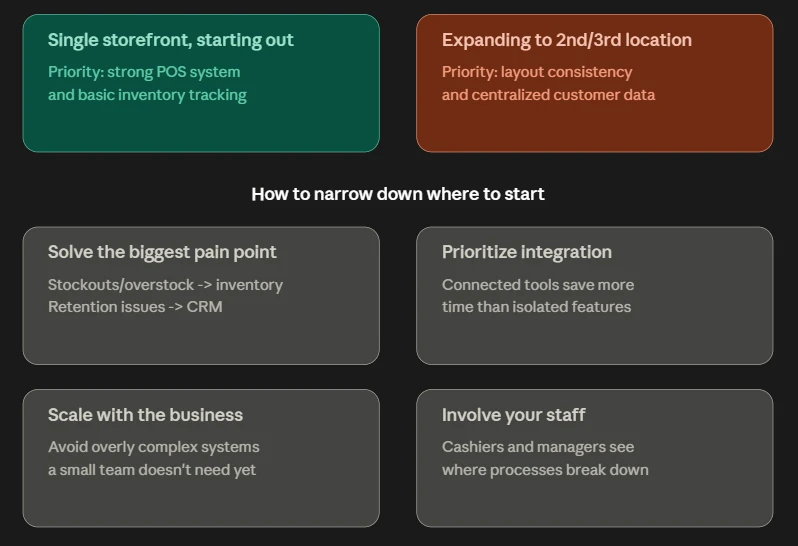
A few practical guidelines can help narrow down where to start:
-
Solve your biggest pain point first. If stockouts and overstocking are a recurring headache, inventory tools should be the priority. If customer retention is the bigger issue, a CRM will likely deliver more immediate value.
-
Prioritize integration over standalone features. Tools that connect with your existing systems save far more time long-term than a feature-rich platform that operates in isolation and requires manual syncing.
-
Scale with your business, not ahead of it. It’s tempting to invest in enterprise-level software early, but overly complex systems can slow down a small team that doesn’t yet need that level of sophistication. Look for platforms that offer room to grow rather than requiring a full switch later.
-
Involve your staff in the decision. The people using these tools daily — cashiers, store managers, stock clerks — often have the clearest sense of where current processes break down. Their input can save a lot of trial and error.
Retail businesses that invest in the right tools today are setting themselves up to compete with far larger players, without needing a far larger budget. The technology that once separated national chains from independent retailers has become genuinely accessible, and the businesses that adopt it thoughtfully — rather than all at once — tend to see the clearest results.
2026 is shaping up to be a year where the gap between retailers running on modern systems and those still relying on manual processes becomes harder to ignore. Whether the first step is a smarter POS system, better inventory visibility, or simply a more organized approach to shelf layout, the goal is the same: fewer daily headaches, better customer experiences, and a business built to scale.